Sunday, August 28, 2005

US Median House Price

The Median House Prices in the United States from 1963 to 2004 is listed in the following table. You can also find the year over year grwoth in the house prices in the third column of the table. There were only two instances in the last 4+ decades when the year over year growth in the median prices of the home was negative. After one such instance, from 1969 to 1970, the median house prices rose sharply in the 70s; and before another small decline in 1990 the prices rose in the mid 80s. The average growth rate for the median house prices for the last 41 years is 6.26%.

Note: To see the latest median and average house price go to my latest post "Median and Average House Prices in USA Since 2000"

YearMedian House PricePercent Gain
1963$18,000.005.00%
1964$18,900.005.82%
1965$20,000.007.00%
1966$21,400.006.07%
1967$22,700.008.81%
1968$24,700.003.64%
1969$25,600.00-8.59%
1970$23,400.007.69%
1971$25,200.009.52%
1972$27,600.0017.75%
1973$32,500.0010.46%
1974$35,900.009.47%
1975$39,300.0012.46%
1976$44,200.0010.40%
1977$48,800.0014.13%
1978$55,700.0012.92%
1979$62,900.002.70%
1980$64,600.006.65%
1981$68,900.000.58%
1982$69,300.008.65%
1983$75,300.006.10%
1984$79,900.005.50%
1985$84,300.009.13%
1986$92,000.0013.50%
1987$104,500.007.65%
1988$112,500.006.66%
1989$120,000.002.41%
1990$122,900.00-2.35%
1991$120,000.001.25%
1992$121,500.004.11%
1993$126,500.002.76%
1994$130,000.003.00%
1995$133,900.004.55%
1996$140,000.004.28%
1997$146,000.004.45%
1998$152,500.005.57%
1999$161,000.004.96%
2000$169,000.003.66%
2001$175,200.007.07%
2002$187,600.003.94%
2003$195,000.0013.33%
2004$221,000.00N/A
Average Median House Price Growth6.26%


The following chart depicts the data above. The last data point of 2004 looks out of sync. We may see some mean reversion in the following year. I hope this chart provides a clear picture to you about the US housing market.


US Median House Prices
One important thing to think about from this post. The median house prices rose on average 6.26% each year for last 40+ years, and today's mortgage rates are below 6%.

All disclaimers apply.

Data Source: http://www.census.gov/const/uspriceann.pdf

Saturday, August 27, 2005

Yield Curve Approaching Inversion

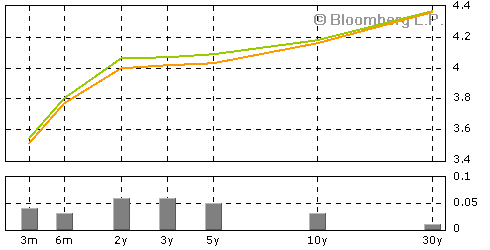
In case if you haven't noticed it, the yield curve is about to invert between the 2 to 5 year range. The 2 year bond is currently yielding 4.05%, while the 5 year bond is yielding 4.08%. We could get the inversion in the next few trading days. The 10 year, at 4.17% is not too far away. The 30 year bond yield has been shrinking lately and it stood at 4.36% at the end of the trading day today.

Conundrum. Indeed.

Yield Curve
Source: www.bloomberg.com

Friday, August 26, 2005

Low Duration Ultrashort Bond Funds

During the rising interest rate environment holding long term bonds may not be a good idea. Although money market yields are somewhat respectable today with rates around 3%, extending the duration a little bit should be able to get the investor some extra return.

The short-term bonds with duration around 2 or 3 may be a stretch for some investors. The duration of 1 or less should be ideal for today’s environment. Following are a few ultrashor/low duration type of funds with no-load, low expense ratio and investable minimumns (less than $5,000).

Schwab YieldPlus Fund (SWYPX)

  • Expense ratio 0.59%
  • Average Maturity 0.4 years
  • 30-day SEC yield 3.87%
  • Total net assets about $740 millions
  • $2,500 regular account minimum initial purchase

Harbor Short Duration (HASDX)

  • Expense ratio 0.39%
  • 30-day SEC yield 3.47%
  • Total net assets about $54 millions
  • $1,000 regular account initial investment

Fidelity Ultra Short Bond Fund (FUSFX)

  • Expense ratio 0.45%
  • 30-day SEC yield 3.51%
  • Total net assets $903 millions
  • Average maturity 1.6 years
  • Duration 0.3 years
  • $2,500 regular account initial investiment

Sunday, August 21, 2005

Focus Funds

I define “Focus Funds” as the mutual funds that invest a large portion of the portfolio in relatively few stocks. The managers of these funds focus on a few stocks that they believe will outperform the overall indexes and invest heavily in them. The methodology of these funds is not to ‘buy a few of a lot’ but instead ‘buy a lot of few’. Meaning, these funds do not invest tiny amount of money in hundreds and hundreds of stocks but instead focus on a few stocks and hold relatively large positions in them.

If you ever wanted to buy a fund that follows the Benjamin Graham/Warren Buffett investment principals then these funds will fit the mold. The fund managers of these funds may or may not agree with this assertion, but if ever you wanted to find a fund which holds relatively large positions in few stocks, which is what Warren Buffett did and is doing in his investment career, then look no further. The table below lists some “Focus Funds”. A couple of these “focus funds” hold Berkshire Hathaway as their largest holding. What does it say about the funds and the philosophy of their managers?

As the table illustrates, these “focus funds” hold at least 5% or greater amount of the fund holdings in the single stock. In each case, the top 10 holdings take up as much as or close to 50% of the total fund portfolio.

Fund NameLargest Holding% in top 10 holdingsPerformanceManager Name
CGM Focus (CGMFX)Murphy Oil
(5.64%)
52.82%19.5%* G. Kenneth Heebner
Clipper (CFIMX)Freddie Mac
(9.3%)
49.50%14.04%James H. Gipson
Fairholme (FAIRX)Berkshire
Hathaway
(18.94%)
66.68%18.75%*Bruce Berkowitz
Janus Twenty (JAVLX)UnitedHealth
Group
(11.76%)
57.59%11.22%Scott Schoelzel
Legg Mason
Growth Trust
(LMGTX)
Amazon.com
(6.83%)
51.79%11.65%Robert Hagstrom
Legg Mason
Value Trust
(LMVTX)
Nextel Communication
(8.16%)
48.53%15.99%Bill Miller
Longleaf Partners (LLPFX)Vivendi
(6.7%)
55.30%13.10%Mason Hawkins,
Staley Cates,
John Buford
Matthew 25 (MXXVX)Polaris Industries
(21.52%)
84.16%15.89%*Mark Mulholland
Oakmark Select (OAKLX)Washington Mutual
(15.15%)
62.01%19.31%* Bill Nygren,
Henry Berghoef
Sequoia (SEQUX)Berkshire
Hathaway
(35.30%)
82.92%14.69%Robert Goldfarb

What common characteristics do you see in these funds?

Here is what I see in them:

  • A focused portfolio
  • Below average expense ratio (exceptions: Two Legg Mason funds)
  • Market beating performance
  • Very low turnover; which translates into very good after tax returns

Here are some of the noteworthy things about these funds:

  • The Warren Buffett connection. Firholme and Sequoia hold significant amount of money in Berkshire Hathaway. The manager of Legg Mason Growth Trust, Robert Hagstrom, has written a book about Warren Buffett style of investing.
  • The Legg Mason Value Trust has beaten the S&P 500 index for 14 consecutive years.
  • The Sequoia fund was closed in 1982 and it remains closed for new investors today.
  • Some of these funds hold large cash positions today. We have heard from Warren Buffett many times that he is not afraid of holding large cash positions until appropriate opportunity presents itself.

I read market commentaries and shareholder reports of these managers each quarter. The market commentaries and shareholder reports are available on the respective mutual fund website.

I intend to find some other funds with similar “focus” philosophy and add them to this table. If you are aware of some other focus funds then leave a comment at the bottom of this post or send me an email and I will update the table. Please only send the funds with at least 5 years of performance record and at least 100 million of assets under management.

Discloser: I do not own any of the mutual funds mentioned in this post. All disclaimers apply.

* All Performance is data is based on 10-year performance, except these funds with less than 10 year performance record: CGM Focus (inception: 9/3/97), Fairholme (inception: 12/29/99), Matthew 25 (inception:10/16/1995), Oakmark Select (inception: 11/1/96).

Saturday, August 20, 2005

Money Market Funds

Money market funds are coming back to life with yields approaching 3% or better. During the last year, the rates have come from below 1% to 3% following the Fed Funds rates. If the Federal Reserve keeps raising the rates going forward then the Money Market rates should approach 4% by the end of this year. Below is the list of Money Market Funds from the major fund families.

Vanguard Prime Money Market Fund (VMMXX)
  • Current yield is 3.18%

  • Expense Ratio of 0.30%

  • Average Maturity of the holdings is 36 days

  • $3,000 minimum is required for General Non-IRA account

  • Assets of about $51 billion

Fidelity Cash Reserves (FDRXX)
  • Current yield is 3.16%

  • Expense Ratio of 0.42%

  • $2,500 minimum initial investment required for General Non-IRA account

  • Assets of $59.5 billion

Fidelity Select Money Market (FSLXX)
  • Current yield is 3.23%

  • Expense Ratio of 0.39%

  • $2,500 minimum initial investment required for General Non-IRA account

  • Assets of about $617 millions

Fidelity US Government Reserves (FGRXX)
  • Current yield is 3.16%

  • Expense Ratio of 0.35%

  • $2,500 minimum initial investment required for General Non-IRA account

  • Assets of about $2.3 billion

T. Rowe. Price Prime Reserve (PRRXX)
  • Current yield is 2.94%

  • Expense Ratio of 0.62%

  • $2,500 minimum initial investment required for General Non-IRA account

  • Weighted average maturity is 42 days

  • Assets of about $4.9 billion

The data is as of August 20, 2005. The accuracy of the data cannot be guaranteed. All disclaimers apply.