Friday, July 29, 2005

Large Cap Stocks And Index Funds

One of the most widely mentioned problems with index fund is that a few large cap stocks are allocated significant amount of money in the fund. The critics argue that a handful of large companies more or less determine the returns of the index fund. As is the case today, the ten largest companies in the S&P 500 index account for 20% or more in the index. The opponents of the market capitalization weighted index funds argue in the favor of equal weighted index fund where each holding is given equal weight in the index.

The top ten stocks of the S&P 500 index today are: GE, ExxonMobil, Microsoft, Citigroup, Pfizer, Johnson & Johnson, Bank of America, Wal-Mart, Intel, American International Group; in that order. These ten companies accounted for 21.1% of the S&P 500 index on 6/30/2005. The top holding GE accounts for 3.4% of the index fund holdings.

Now, Let’s examine GE closely.

You may not know this, but GE is actually a collection of 11 different business units working under the umbrella of the name General Electric. These 11 units are:
  • GE Advanced Materials
  • GE Commercial Finance
  • GE Consumer Finance
  • GE Consumer & Industrial
  • GE Energy
  • GE Equipment Services
  • GE Healthcare
  • GE Infrastructure
  • GE Insurance Solutions
  • GE Transportation
  • NBC Universal.

See for yourself. Now, that 3.4% of the index fund is actually made up of 11 different business units. Some of these businesses are multi-billion dollar businesses. So, if the GE was ever to spin-off its businesses in 11 individual companies, it will still account for 3.4% of the S&P 500 Index, all things being equal.

My point is that if GE (a collection of 11 businesses) takes up 3.4% of the index fund then there is nothing wrong with that. The index fund investors need to alter their thinking method. They should not to be afraid of the 3.4% weighting given to GE. They should not think that too much money is riding on a single horse. The 3.4% allocation is nicely divided among 11 business units underneath.

If you scratch the surface of the other remaining 9 companies (from ExxonMobil to AIG), you will find that they also do not do one single thing. These businesses are diversified under the surface. Please keep this in mind while investing.

All disclaimers apply.

Saturday, July 23, 2005

Bonds and Real Returns

From 1926 to today, inflation has averaged about 3% per year. In order to stay even with the inflation an investor must earn after tax return of 3% each year. If you are in top most tax bracket, then the income from bonds is currently taxed at 35%.

The 10-year bond currently yields 4.21%. After paying 35% tax on this income, this investor will earn 2.73% return over the 10-year period. In real terms, the investor will lose 0.27% to inflation.

The 30-year bond has the yield of 4.43%. After paying 35% tax on this bond income, the investor will earn 2.87% return over the 30-year period. In real terms, the investor will lose about 0.13% annually to inflation.

In today’s low rate environment, bonds do not provide a real return. Some may argue that the inflation will not average 3% for the next 30-years, the market is not expecting it. Precisely. The market rarely accommodates the majority. The inflation expectations are too low today. Be prepare for a surprise.

All disclaimers apply.

Friday, July 22, 2005

Reliance Industries - India

Reliance industries/Group is the India’s largest company in terms of Market Capitalization. I found some interesting numbers from the Reliance’s web-site.
  • Reliance accounts for 17% of the total private sector profit of India.
  • Reliance earns 7% of the total corporate sector profit of India.
  • Reliance accouts for 6% of the total market capitalization of the Indian stock market.
  • 25% of investors in India own Reliance stock!!
  • Has revenues of $17 billion.
  • Earns cash profit of $2.1 billion
  • Owns assets of $16.3 billion.
  • The Reliance group contributes 10% of the India’s indirect tax revenues!!
  • 13% of the BSE Sensex (DOW of India) is Reliance.
  • Reliance is 10% of the Nifty Index.
  • Exports its products to more than 100 countries.
  • Reliance's business are refining and marketing of oil and gas, petrochemicals, polyester, polymers, textiles, financial services, insurance, power, and telecom.

May I say, India’s GE?.

All disclaimers apply.

Wednesday, July 20, 2005

Money Market Yield above 3%

The yield of the Vanguard Prime Money Market Fund (Symbol: VMMXX) is now at 3.02%. The Vanguard Federal Money Market Fund (Symbol: VMFXX) is yielding 3.01%. The Federal Reserve Chairman Allen Greenspan painted an upbeat picture of the national economy today. With this improving economy, it is expected that the Fed will raise the rate at the next meeting, so money market rates should approach 3.50% and probably 4% by the end of this year.

It is also important to note that the long bond yields are also rising in the last couple of weeks. The 10-year bond is yielding 4.15% and 30-year bond is yielding 4.39% today.

I think it is safe to say that the parked money is working for you.

Sunday, July 10, 2005

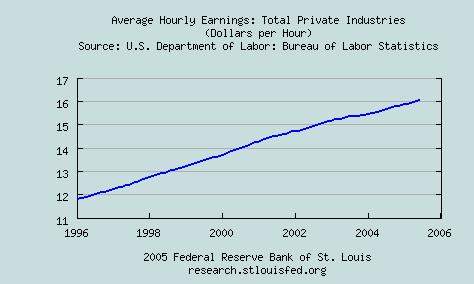
US Average Hourly Earnings Chart

Above chart displays the Average Hourly Earnings in US since 1996. As you can see, the slope of the chart is very consistent. The growth in the wages is almost a straight diagonal line from one corner of the chart to the another.

This chart is a linear chart. Unfortunately, a line like above in a linear chart shows slowing growth!! I would like to see some parabolic action in this chart because we have already had parabolic climbs in the housing prices in the US. If the wages do not show any accelerated growth, then some consumer discretionary stocks and housing sector may get into trouble in the coming years.

As always, all disclaimers apply.

Friday, July 08, 2005

Slow Growth Or No Growth

The widespread belief in the market today is that the earnings will slow down in the coming year. The headlines in the financial sections of the newspapers are filled with rising oil prices and housing bubble stories. Overall market is expecting bad news from the economy and is ready to dump the stocks as soon as some bad news comes forward. In this rocky market situation, we need to take a step back and re-evaluate the impact of slowing earnings on the equities.

Let’s not consider the slow earnings growth for now. Let’s take it a step further and consider for a moment “no” earnings growth for the next five years in the S&P 500 index. This year in 2005, the expected earnings estimate for S&P 500 is $75.02 on as reported basis. Now assume that for next 5 years, from 2006 to 2010, S&P 500 earns $75 each year. Even in this static situation the total earnings for the next 5 years will be $375.

So, “no” growth gives you $375 for next 5 years.

The current price we are paying for S&P 500 is about $1200 for $75 earnings each year. The inverse of the P/E ratio, the E/P of S&P 500 is 6.25%. In a “no” growth environment the index investment can be considered as a bond with 6.25% yield. The current 10-year bond yield is about 4% and 30-year bond yields about 4.30% for comparison purposes.

All disclaimers apply.

Saturday, July 02, 2005

Relative Valuations of Various Indexes

Following table lists the P/E ratios and earnings growth rates of all vanguard index funds as of 5/31/2005. I find it very useful from time to time to take look at the relative valuations of various indexes to find out overvalued and undervalued spectrums of the entire market. If you believe in the idea of "what goes around, comes around" or "Market rarely accomodates the majority view" then you could find areas to invest and areas to avoid by just looking at the table below. Abandoning entire sector or spectrum of the market is never a good idea but the new money should be directed in the direction the following table is pointing. Please bring your own compass and determine the direction. My views are listed below the table.

Vanguard Index Fund NameP/E RatioEarnings Growth Rate
500 Index Fund Inv18.110.7
Growth Index Fund Inv24.314.3
Total Stock Mkt Idx Inv1911
Value Index Fund Inv158.2
Mid-Cap Index Fund Inv20.613
Small-Cap Growth Index2717.7
Small-Cap Index Fund Inv21.810.1
Small-Cap Value Index18.34.9
REIT Index Fund Inv38.7-4.7
Emerging Mkts Stock Index10.721.2
European Stock Index Inv16.44.5
Pacific Stock Index Inv13.513.5

  • The most important thing I notice in the table is the line of REIT index fund. The P/E ratio of 38.7 and negative earnings growth makes me worried about the real estate market.
  • The small cap stocks are perceived as riskier investment in the investment community, still, they field higher P/E ratio and lower earnings growth then S&P 500 index fund.
  • Emerging markets stock index fund has the lowest P/E ratio and highest earnings growth among all indexes.

All disclaimers apply.