Friday, March 31, 2006

Share Buybacks Plus Dividends

There has been a surge in stock buyback activities in recent months. The Standard & Poor’s has announced that the share buybacks surged 57% in the forth quarter of 2005 compared to forth quarter of 2004. The S&P reports $103 billion worth of stock repurchases by S&P 500 companies in the forth quarter of 2005, compared to $66 billion in the forth quarter of 2004.

The repurchase activity is jumped so much that the combined dividend yield and buyback yield is now approaching 5% range. One has to wonder that if the recently reported record earnings are a byproduct of these share buybacks. As total number of shares go down the earnings per share increases even if the total earnings do not increase.

Three mega-cap companies GE, Microsoft and Exxon accounted for the 17.9% of the total buybacks. The information technology sector was responsible for the 28.5% of the buybacks even though it only represents about 15.3% of the S&P 500 index.

The data from S&P is listed below in the table. The most important column is the right most column. The buyback yield plus dividend yield is approaching 5% now!

YearMarket
Value
Billions
Dividends
Billions
Buybacks
Billions
Buybacks
+
Dividends
Billions
Buybacks
+
Dividends
Yield
12/31/2005$11,255$202$349$5514.90%
12/31/2004$11,289$181$197$3783.35%
12/31/2003$10,286$161$131$2922.84%
12/31/2002$8,107$148$127$2753.39%
12/31/2001$10,463$142$132$2742.62%
12/31/2000$11,715$141$151$2922.49%
12/31/1999$12,315$138$141$2792.27%

Data Source: Buybacks and impact of share count reduction

Wednesday, March 29, 2006

Growth and Value Performance

Value beats Growth over the longer time periods.

Looking at the historical returns of the different asset classes, we see that the value stocks have outperformed the growth stocks on relative basis.

Let’s look at the last 10-year returns of the growth index and value index. For the investment growth calculations we use the performance of the growth index fund and the value index fund for the last 10 years. We use the Vanguard growth index fund and the Vanguard value index fund returns for our calculations.

The growth index fund (VIGRX) has returned 8.52% annually in the 10 years ending 12/31/2005. The return after the taxes on distributions was 8.07% and the total return after taxes on distributions and sale of fund shares was 7.31% annually for the same 10-year period.

The value index fund (VIVAX) has returned 9.44% annually in the 10 year ending 12/31/2005. The return after the taxes on distributions was 7.92% and the total return after taxes on distributions and sale of fund shares was 7.49% annually for the same 10-year period.

As you can see from the numbers above, the value index fund did return close to a full percentage higher than the growth index fund. But an investor who invested in this outperforming value asset class in a taxable account really earned a higher rate of return? The value index fund in a taxable account is at a distinct disadvantage. The value fund has a higher dividend yield compared to the growth fund. The dividend paid out each year by the value index fund is taxed as income and that takes a bite out of the overall return. The growth index fund has a lower yield and the most of the return is capital appreciation and not taxed until the investor sells the shares in the fund.

The returns after taxes on distribution and sale of fund shares are only 18 basis points apart even though the returns before taxes differ by 92 basis points.

The value funds are good choice for the tax-exempt accounts. For taxable account it is a photo finish between the growth and value. With this said, I will rephrase the first statement of this post.

Value beats Growth over the longer time periods in a tax-exempt account.

Monday, March 13, 2006

Index Fund Valuations

The prices to earnings ratios of the Vanguard index funds are listed in the table below. The data listed here are as of 1/31/2006. The Vanguard index funds do a very good job of replicating their respective indexes in terms of market returns, also they are a very good proxy for the numbers like P/E ratios and dividend yields for the corresponding benchmark indexes.

Fund NameSymbolP/EEarnings
Yield
Dividend
Yield
500 Index Fund InvVFINX17.15.84%1.68%
Growth Index Fund InvVIGRX22.94.36%0.69%
Large-Cap Index Fund InvVLACX17.85.61%1.57%
Total Stock Mkt Idx InvVTSMX18.55.40%1.55%
Value Index Fund InvVIVAX14.46.94%2.45%
Extended Mkt Index InvVEXMX25.53.92%0.99%
Mid-Cap Index Fund InvVIMSX21.14.73%1.01%
Small-Cap Growth IndexVISGX29.63.37%0.23%
Small-Cap Index Fund InvNAESX23.94.18%1.07%
Small-Cap Value IndexVISVX19.85.05%1.93%
REIT Index Fund InvVGSIX382.63%3.74%
Emerging Mkts Stock IndexVEIEX13.17.63%-
European Stock Index InvVEURX14.96.71%-
Pacific Stock Index InvVPACX21.84.58%-

Some observations:
* Small cap index funds are richly valued.
* The broader small cap index and small cap growth index funds have P/E ratios well above 20. The small cap growth index fund has bubble like P/E ratio of 29.6.
* The small cap value index is valued at 19.8 times the earnings. In comparison, the total stock market index has P/E ratio of 18.5. Here we have an instance of value having rich valuation than blend.
* The Large cap value index remains relatively cheap to other indexes. It also has a good dividend yield of 2.45%.
* REIT index's P/E ratio is in the stratosphere.
* Pacific stock index that includes substantial holdings in Japan is not cheap either.
* Emerging markets index has the lowest P/E ratio of the group.

Data Source: The Vanguard Group

Monday, March 06, 2006

Insider Activity Predicting Slowdown Ahead?

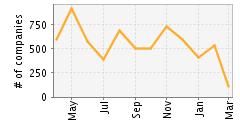
Above chart displays the number of companies with net insider purchases of the company stock. The "net insider purchase" companies are companies where insiders bought more shares than they sold.

This chart is alarming. The number of companies with net insider purchases is almost approaching zero. Is smart money leaving the market?

Chart Source: Form 4 Oracle Insider Trading

Sunday, March 05, 2006

Tax, Inflation and Stock Market Returns

Taxes take a good bite out of the investment returns when added into the total return equation. Let’s consider the largest index fund returns for the last 10 years to make a point.

The vanguard 500 index fund (Symbol: VFINX) is the largest index fund and it is also extremely tax efficient. The 10 year before tax annualized return is 9% currently. Vanguard reports that the returns after taxes on distributions was 8.44% annualized for the last 10 years. And here comes the kicker, returns after taxes on distributions and sale of fund shares was 7.67% annualized for the last 10 years.

Now, I am going to add inflation to the equation. I would like to use 4% annual inflation rate instead of the government reported 3% rate because there is a widespread belief in the sane investment community that the real inflation is close to 4%, if not higher.

Subtract 4% from the 7.67% and you are left with 3.67% real return from your index fund investment. Even if you use the government reported data and subtract only 3% for inflation, the real return stands at 4.67%.

Most of the money invested today does not go to the index funds. Actively managed funds are in business and collectively tend to lag the market by 2%. Those funds leave investors with zero to close to zero gain when Uncle Sam collects and inflation takes its toll.